


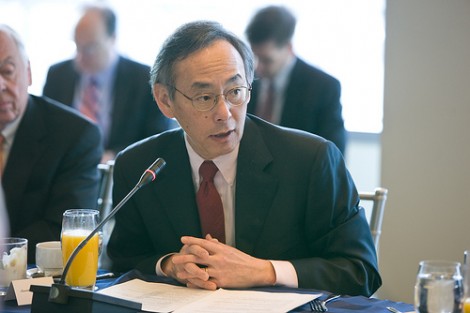
U.S. Energy Secretary Steven Chu announced that six carbon dioxide (CO2) emissions-capturing projects have been selected to receive $106 million from the American Recovery and Reinvestment Act. Each project demonstrates the potential for using CO2 as an inexpensive raw material that can reduce carbon dioxide emissions while producing useful by-products such as chemicals, carbonates, plastics, fuels, building materials, and other commodities.
"These innovative projects convert carbon pollution from a climate threat to an economic resource," said Secretary Chu.
It is anticipated that large volumes of CO2 will be available as fossil fuel-based power plants and other CO2-emitting industries are equipped with CO2 emissions-control technologies to comply with regulatory requirements.
These projects initially received first-phase-funding in October 2009, and now enter a second phase of design, construction, and pilot-scale operation.
Theyinclude:
Alcoa, Inc. -- $11,999,359 -- This pilot-scale process will demonstrate the high-efficiency conversion of fluegas CO2 into soluble bicarbonate and carbonate using an in-duct scrubber system featuring an enzyme catalyst. Scrubber blow down can be sequestered as solid mineral carbonates after reacting with alkaline clay, which is a by-product of aluminum refining. The carbonate product can be used as construction fill material, soil amendments, and green fertilizer. Alcoa will demonstrate and optimize the process at their Point Comfort, TX aluminum-refining plant.
Novomer Inc. -- $18,417,989 --Teaming with Albemarle Corporation and the Eastman Kodak Co., Novomer will develop a process for converting waste CO2 into plastics for use in the packaging industry. This catalyst technology enables CO2 to react with petrochemical epoxides to create a family of thermoplastic polymers that are up to 50% CO2 by weight. Phase 2 work will be performed at sites in Rochester, NY, Baton Rouge, Louisiana, and Orangeburg, SC.
Touchstone Research Laboratory Ltd. -- $6,239,542 -- This project will pilot-test an open-pond algae production technology in Cedar Lane Farms in Wooster, OH that can capture at least 60% of fluegas CO2 from an industrial coal-fired source to produce biofuel and other high value co-products. A phase-change material will cover the algae pond surface to regulate daily temperature, reduce evaporation, and control the infiltration of invasive species. Lipids extracted from harvested algae will be converted to a biofuel, and an anaerobic digestion process will be developed and tested for converting residual biomass into methane. (site: TRL)
Phycal, LLC -- $24,243,509 -- An integrated system will produce liquid biocrude fuel from microalgae cultivated with captured CO2. The algal biocrude can be blended with other fuels for power generation or processed into a variety of renewable drop-in replacement fuels, such as jet fuel and biodiesel. Phycal will design, build, and operate a CO2-to-algae-to-biofuels facility at a nominal 30-acre site in Central O'ahu, HI.
Skyonic Corporation -- $25,000,000 -- SkyMine mineralization technology transforms CO2 into solid carbonate and/or bicarbonate materials while also removing sulfur oxides, nitrogen dioxide, mercury and other heavy metals from fluegas streams of industrial processes. Solid carbonates are ideal for long-term, safe aboveground storage without pipelines, subterranean injection, or concern about CO2 re-release to the atmosphere. This will take place at a Capital Aggregates, Ltd. cement manufacturing plant in San Antonio, TX. (site: Skyonic)
Calera Corporation -- $19,895,553 -- This process directly mineralizes CO2 in fluegas to carbonates that can be converted into useful construction materials at an existing facility in Moss Landing, CA. The project team will demonstrate a scaled-up version of a production system that, at smaller scales, has produced carbonate-containing aggregates suitable as construction fill or partial feedstock at cement production facilities. (site: Calera)
Comments
Very interesting .. Hopefully some useful (and economically realistic) technology comes from this funding!