



ChE is what a ChE does
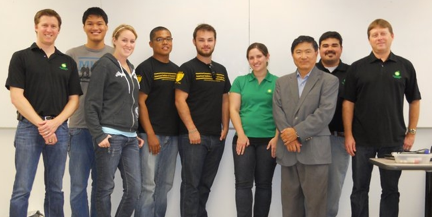
Bette Lawler, AIChE's director of operations, tells me that when she calls about membership renewals, she often hears the comment, "I'm not really doing chemical engineering anymore." Most often, that turns out to mean that they aren't doing process engineering! ChEs do many things in addition to process engineering. To name a few areas, we also bring our skills to bear on R&D, management, finance, business, design, sales, technical service, testing, human resources, education, law, medicine, governing, intelligence services, and space flight. Chemical engineering is not defined narrowly by the industries we work in, which are remarkably diverse. Oil, gas, and petrochemicals are key sectors for our profession, and the excitement about new opportunities there is high. At the same time, we have long records of achievement in pharma, polymers, food, nuclear energy, environmental control, paper, and packaging. ChEs are also taking leading roles in new areas as diverse as tissue engineering, personalized medicine, nanotechnology, petascale computing, sustainability metrics, and microfluidics. Ask ChE students what their interests are. You'll find a wide range. For example, at the AIChE Student Chapter of California State University - Long Beach, students listed water, sustainable manufacturing, medicine, auto racing, business, biofuels, automated environmental-control systems, and microelectronics.
Our core (1): "Molecular science" is our foundation

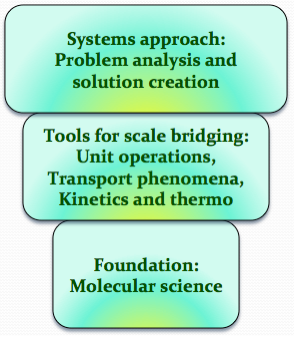
Ten years ago, Bob Armstrong of MIT led a broadly based effort of academics and industrial practitioners titled "Frontiers of Chemical Engineering Education," aiming to develop a new framework for the undergraduate curriculum. One of their insights was that each engineering discipline has three aspects: Its core area of science, a systems approach to problem-solving, and their concepts and analytical connectors (see graphic).
Chemistry is the core science of our profession. At the same time, chemistry has broadened to encompass biology and materials so "molecular sciences" is a better description. From that point of view, a definition of chemical engineering is "the profession that applies molecular sciences." If you're doing sales or chemical process control or patent law or tissue engineering, for example, does that definition fit? I think so. Consider the contrasting time scales of ChE vs. electrical-engineering process control: seconds and minutes, vs. milliseconds and microseconds. Tissue engineering is using living cells, but we now understand that biochemical pathways are keys to their viability. Physics and math and even social sciences of ChE all play vital roles, too. Each engineering discipline is centered on some domain of science, and applied molecular sciences is ours.
Our core (2): We're systems engineers - from the start
To tackle these problems or any problem, you first have to grasp what the problem is - what the system is. "Systems" is probably not how you were introduced to it, but ChEs' initial tool of choice is often writing balances on a system in terms of amounts of material or money or flowrates or energy. Think what a distinctive strength that is. We learn a systems approach from the start of our careers and then apply it to problem-solving and creative processes throughout our careers. Other engineering disciplines have typically first learned the fundamentals and then put them together into systems by their senior undergraduate year. For ChEs, it's always been ingrained from the start.
These two aspects shape ChE
The bridging tools in our technical toolkit include thermodynamics, kinetics, unit operations, and transport phenomena, and they make up much of the common education background ChEs have. ChE stretches beyond using those particular tools, though, and at some point in your work you may not use them at all. Rather, I think that ChE is best characterized by (1) applying molecular sciences and (2) starting from a systems perspective. Regardless of whether your assignment is to develop a P&I diagram or supply-chain management or an environmental assessment or personalized medicine, these two features say you're a chemical engineer. Next week, I'll conclude this series by writing about the opportunities and challenges we face as we enter a new Golden Age of Chemical Engineering.
Comments
This post identifies two distinguishing, common features of ChEs as (1) applying molecular sciences and (2) having a common starting point of tackling problems and projects from a systems perspective that we learned the beginning of our studies. Do you have ideas that would refine or expand that list?