

-

-
Topics:
Hello again from the Travel Desk, bringing you another engineering sight.

This trip takes us to Seoul, South Korea or, more specifically, to Seonyudo Park. Seonyudo Park is located on an island in the Hangang River as it winds its way through western Seoul. Until 1998 this island was home to a sewage treatment plant serving Seoul. As operations shifted and the facility was shut down, the Seoul Metropolitan Government looked for a way to turn the industrial island into an asset instead of a liability.
Seonyudo Park - How it Came To Be:
Of the proposals submitted, the winner was a plan transforming the island into an ecologically themed park and educational space. Some of the facility was completely demolished, while selected structures were partially deconstructed and retooled as gardens, performance space, or simply little retreats from hectic urban life. The current space is very much a relaxing park,
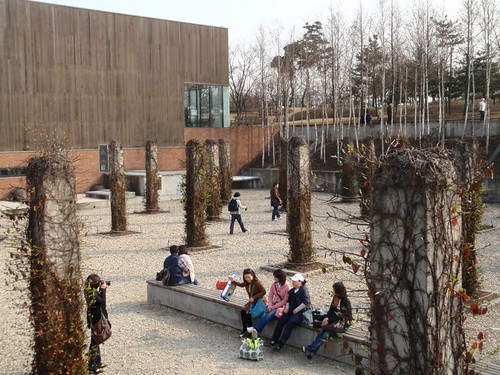
but its past is not relegated to history. Some of the old pumps, valves, and other equipment were kept and put on display. The footprint of the old facility is marked with new Poplar trees. One of the concentrating basins was turned into a playground while another became an amphitheater. You can lunch in the caf? located in the old pump house. The roof was removed from the underground clean water reservoir and is now a quiet space populated with ivy covered columns. Settling basins now contain gardens.
Seonyudo Park - Aesthetics and Access as Part of The Master Plan
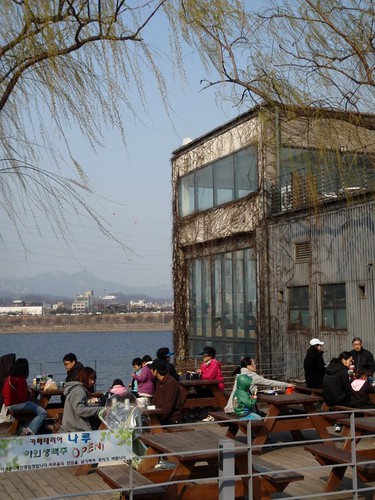
There were also some strategic new elements constructed, such as a new pedestrian bridge, a visitor center, and a green house. The pedestrian bridge, while possessing definite aesthetic qualities, increases access and helps connect the island to the city. The visitor center has display and presentation space, with the current exhibit presenting concepts of how cities and people interact with and affect nature. There are many facts and figures presented on energy and the resource usage of the residents of Seoul and how individuals can reduce their environmental impact. Some of the space is also dedicated to the Hangang River Renaissance Master Plan. This master plan tells of a transformation of the river banks from an afterthought of urban planning to an expansive multi-use network of civic and private buildings. The proposed themed neighborhoods range from business centers to sporting complexes to residential towers, each planned with features that will help return the river to a cleaner, more natural state and maximize the benefit of such a resource for the people of the city.
Seonyudo Park - Slices of Soeul Life
On my visit to the park there were people from all slices of Seoul. School groups taking in the educational displays, young couples enjoying some quiet time with nature, amateur performers doing live performances of their favorite anime, picnicking families, and photographers honing their craft, to name a few. I think the real beauty of the park is how it preserves a bit of the past and shows a path for the future, all while providing a better present.
Seonyudo Park Photos:
The transformation of Seonyudo Park benefited from the fact that the old treatment plant was the only resident of the island and, being an island, there were no neighbors to get approval from. The Master Plan is much more ambitious in complexity and scale, requiring more work from a more diverse coalition--and throw in a challenging economic environment for good measure. But what makes the Master Plan more difficult are the very aspects that give the plan so much potential. If the Master Plan is executed as well as the award winning Seonyudo Park has been, Seoul will have a string of jewels along a beautiful natural resource that will be the envy of any city in the world.
Getting there:
- Subway Line #2 to Dangsan Station (Exit #1) then bus (605, 6623, 6631, 6632, or 6633) getting off at Hanshin Apts then walking across the Rainbow Bridge
- Subway Line #2 or #6 to Hapjeong Station (Exit #8) then bus (604, 5712, 6712, or 6716) or walk to Hanshin Apts then walking across the Rainbow Bridge
Travel website references:
From: Life in Korea: Seonyudo Park | Seoul City
Official Site of Korea Tourism Org.: Seonyudo Park
Good blog reference:
my nice day!: field trip #1: seonyudo park
Seonyudo Park is also a featured image in the ChEnected in the Real Contest.
Do you know of any examples of transformations similar to Seonyudo Park? Thoughts?
Related articles by Zemanta
- Saving the World, One Sewage Treatment Plant at a Time (cleantechnica.com)
- Seoul Gangnam District's sustainable masterplan for public housing (ecofriend.org)
Comments
This is great Robert! Thanks for sharing! I am trying to think of any US examples... I know in Richmond, VA, Belle Isle used to have a power plant (i think) and parts of the Iron Works on it but is now strictly a park and recreation Island - not nearly as fancy as Seonyudo park!
Thanks! Most of the examples I have seen in the US are sites were they level the old facility and put a soil cap on top. There might be a plaque or a couple pieces of old machinery set up. There is a park adjacent to a Chicago water treatment plant, but you can't go in it. There are some old steel plants that are being covered up and turned into lakefront space, but like you say nothing as fancy as this.
Our old Steel Plant was turned into a Casino. I'd rather a park, myself.
Robert, great post :) I really enjoyed reading this because I had no idea about this island and I'm from Korea! Well, I haven't been there since 2003 but apparently a lot has changed since then--especially in regards to engineering and construction. I'll have to make a visit soon and definitely drop by Seonyudo Park.
Thanks, glad you enjoyed it. There is definitely a lot changing there. And coming from the US, a city that size is impressive just to see in general. There is also a large fish market nearby if you need somewhere interesting for lunch.