
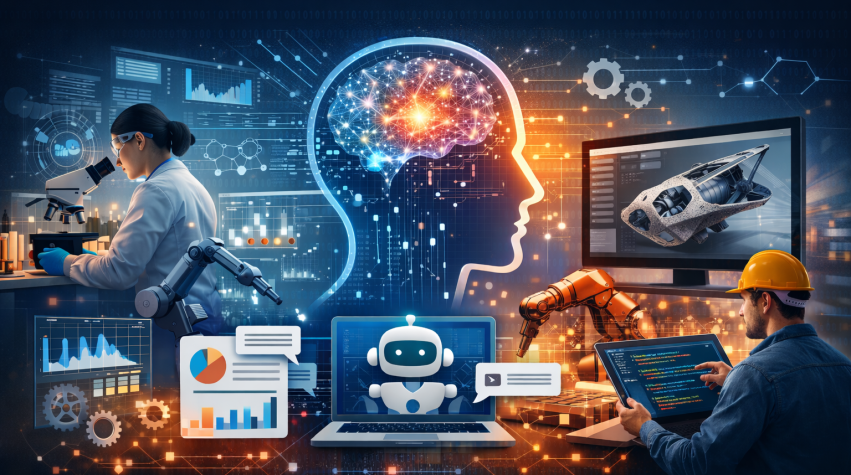
We’re entering a new stage of the technological revolution. Artificial intelligence (AI), automation, and digital tools are changing not just how work is done, but how people create impact. Unlike past waves of automation — which mechanized repetitive tasks — today’s AI and generative technologies are tackling cognitive, creative, and analytical work, from analyzing datasets and generating reports to summarizing meetings and drafting communications. We’re going to explore practical ways that engineers can apply AI in day-to-day work.
Using AI to stay ahead in your field
AI and machine learning are transforming productivity and impact in STEM fields. For example, in R&D, platforms like Sapio Sciences offer AI-native electronic lab notebooks, research platforms, and other advanced tools that can adapt to lab workflows and streamline data analysis, literature review, hypothesis generation, and experimental planning. In engineering, AI-driven tools like TensorFlow, PyTorch, and Scikit-learn analyze patterns, predict outcomes, and inform decision-making, from anticipating equipment failures to designing more efficient systems. Modern CAD tools such as Autodesk Fusion 360 and SOLIDWORKS now include generative design features, enabling engineers to explore complex geometries and evaluate design options more quickly.
Bringing AI into your everyday work
Beyond these advanced tools, everyday AI assistants — such as ChatGPT, Perplexity, and Copilot — can immediately improve your daily lab or engineering productivity. They can summarize datasets, generate narratives or reports, and spot trends or anomalies when guided with the right prompts. Perplexity, for example, is unique in its ability to mimic an expert research process by performing iterative searches, analyzing resources, and creating a comprehensive report from the gathered information. Unlike conversational AI, it provides citations for its answers and prioritizes factual accuracy and information retrieval, which is great for research. For those whose work involves writing and editing code, GitHub Copilot can be a helpful AI coding assistant for writing scripts to clean, normalize, and filter data from experimental, simulation-based, and other analytical projects.
AI is also reshaping how teams communicate, share information, and maintain relationships. Many of the same tools you likely already use, such as Zoom, Teams, and Slack, now integrate AI assistants to help improve efficiencies in day-to-day tasks. For instance, if you’re in a project review meeting, AI tools like Copilot can summarize the meeting, generate action items, and highlight key discussion points. Instead of spending an hour writing a summary or rewatching the recording, you can reallocate your time and energy to the important decisions and higher-level work that move projects forward. These may seem like small efficiencies, but collectively they free up mental bandwidth for problem-solving and relationship-building, two key areas where human insight will always matter most.
Technical excellence isn’t enough if people can’t understand the value of your work. One of the more overlooked opportunities lies in how we can use AI to communicate with more empathy, precision, and influence. For scientists, engineers, and other technically minded professionals, this is huge because communication can be the hardest part of the job. AI can do the heavy lifting of drafting, summarizing, or clarifying insights from experimental work, process improvement initiatives, and analytical findings.
For example, let’s say you’ve identified an inefficiency in a distillation process. Generative AI can help you quickly draft a concise summary of the issue, its potential impact, and a proposed solution, translating your “lab speak” or “engineering shorthand” into plain-language talking points for a non-technical or cross-functional audience. In cases where you have to bring up a recurring problem or propose a solution that might cause others to get defensive, AI can help soften the tone or add more assertive phrasing when escalating issues. Once again, these small efficiencies add up, making it easier to influence, teach, and lead beyond your team.
Using AI responsibly
While these tools can save time, human oversight is critical. AI is not infallible. It makes mistakes, misinterprets context, and, on many occasions, makes things up. That’s where your ability to analyze and validate its outputs and apply your own judgment is important for its insights to be meaningful and actionable. There are risks in leaning too heavily on AI without the human element. A human-AI hybrid approach leverages the strengths of both.
When used well, AI can supplement your knowledge, skills, and expertise, helping you work faster, think deeper, and create more impact. You don’t need to become an AI specialist, but understanding how it’s shaping your field, intersecting with your work, and where human judgment complements it is important. Those who embrace and learn to work with AI responsibly and strategically will outpace those who ignore it.
Learn more about applied AI on AIChE Academy.
This article originally appeared in the Career Connection column in the December 2025 issue of CEP. Members have access online to complete issues, including a vast, searchable archive of back-issues found at www.aiche.org/cep. Learn more about AIChE membership.