

As industries work to address climate change and reduce emissions, chemical engineers are helping turn ambitious sustainability goals into practical solutions. In this interview, Scott Collick, Chief Sustainability Officer (CSO) at DuPont, shares his perspective on carbon fluency, value chain transparency, and the role engineers can play in advancing sustainable innovation.
DuPont has made significant commitments around sustainability and climate innovation. From your perspective, what will it take for industry to successfully translate ambitious climate goals into scalable action?
At this point, most companies don’t lack ambition, they lack pathways to scale. If I look at DuPont, we’ve been decarbonizing at scale. We’re down more than 75% in Scope 1 and 2 emissions since 2019 and over halfway on Scope 3 since 2020, so progress is absolutely achievable when you embed it into operations, innovation, and decision-making. But the reality is that, to get to the next level, no company can do it alone.
From my perspective, it comes down to three things:
- First, embedding carbon into everyday business decisions. Carbon has to sit alongside cost, performance, and risk, not as a separate sustainability metric.
- Second, building real carbon fluency across the organization and the value chain. You need a shared understanding of where emissions actually sit and what the real levers are.
- And third, this is the big unlock: value chain transparency. We need consistent, credible product carbon footprints (PCFs) across materials and products.
Today, too much of Scope 3 and decarbonization is still managed with spend-based models. That’s not enough. We cannot decarbonize using spend-based proxies. We have to move to activity-based data and, ultimately, to primary data.
Because, at the end of the day, if we want to scale low-carbon solutions, the market needs to see them, compare them, and value them. That only happens when the data is real, consistent, and flows across the entire value chain.
Large-scale sustainability progress often requires balancing technical innovation, business realities, and long-term investment. How do you approach those competing priorities when leading climate-related initiatives?
I start from a simple principle: products and processes can’t begin with sustainability as the only objective. It has to be one of four dimensions. The best solutions don’t optimize a single variable. They balance price, performance, sustainability, and resiliency as part of one integrated system. For me, every product or initiative has to stand up across those four:
- Price – delivers competitive total system cost
- Performance – meets functional requirements
- Sustainability – reduces total system environmental impact, both footprint and avoided emissions (handprint)
- Resiliency – ensures reliable delivery at scale through diversified supply chains, strong risk management, and flexibility
Winning products and processes succeed because they deliver across multiple dimensions. They have to be technically feasible, manufactured reliably at quality and scale. They have to be economically viable, delivering a clear business case with cost, margin, and willingness-to-pay. They have to be sustainable, meeting rising expectations on footprint, compliance, and license to operate. And they have to be resilient, supported by a robust supply chain that can deliver consistently despite volatility.
You don’t need to win all four, but you need to be strong in at least two, and ideally three, to scale.
AIChE’s Climate Policy Steering Committee is focused on engaging the chemical engineering community around climate solutions and emissions reduction. What role do you think professional societies like AIChE should play in helping engineers collaborate, share knowledge, and drive meaningful progress?
I think professional societies like AIChE play a critical role. If I reflect on my recent work on carbon fluency, the biggest gap we have today isn’t awareness, it’s application. We have more data than ever, more disclosures, and more targets, but we haven’t fully translated that into how engineers make decisions every day.
Engineers need to be as comfortable with carbon as they are with cost, yield, or energy balances. That means understanding both total footprint and intensity and knowing how to use those together to make smarter decisions, not treating them as competing metrics.
But just as importantly, we have to build intuition around carbon. Today, most engineers couldn’t look at a product footprint and say whether it’s “good or bad,” or how it compares to alternatives. We’ve built that intuition over decades in areas like energy, mass transfer, yield, etc., but we haven’t done it yet for carbon. That’s a big opportunity.
Second, it’s about translating data into engineering decisions. We need to move beyond reporting and into application, how carbon data actually informs process design, material selection, and capital decisions. Sustainability should work more like finance, where data is embedded into everyday decision-making, not something reviewed after the fact.
That’s where AIChE can really lead, by helping standardize approaches, build shared understanding, and ultimately turn carbon from something we report into something engineers use and act on every day.
Looking ahead, which emerging technologies, materials, or sustainability approaches are you most excited about, and where do you see chemical engineers having the greatest opportunity to make an impact in the coming years?
What excites me most isn’t just any single breakthrough technology, it’s the opportunity to drive impact through smarter, more efficient systems.
If you step back, some of the biggest opportunities aren’t new inventions, they’re energy efficiency and waste reduction at scale. In many cases, the fastest, lowest-cost way to reduce emissions is to use less energy, improve yields, and eliminate waste across processes and value chains. That’s where chemical engineers can have immediate and meaningful impact.
At the same time, we’re seeing meaningful progress in areas like electrification of plants and processes, which can fundamentally reshape emissions as grids continue to decarbonize.
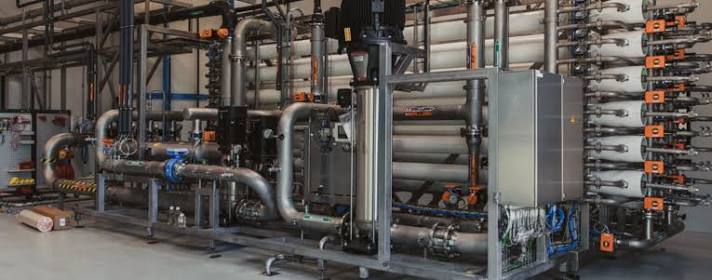
And I’d highlight water as another major opportunity area. Water is increasingly becoming a constraint on growth in many regions, and there’s huge potential to improve water circularity by using less freshwater and reusing more within systems. At DuPont, we’re working closely with customers to dramatically improve water efficiency through technologies like closed circuit reverse osmosis (CCRO). These systems allow customers to recover much more water from their processes, reduce freshwater intake, and minimize wastewater discharge. It’s a great example of how chemical engineers can redesign a system, not just treat water, but keep it in the loop longer and use it more productively.
For me, the biggest opportunity for chemical engineers is this: not just inventing new materials, but redesigning systems to be simpler, more efficient, and more scalable, using carbon fluency to inform decisions. That means:
- Optimizing processes to reduce energy intensity, lower GHG emissions, and improve yields
- Designing out waste, materials, emissions, and complexity
- Building circularity into both carbon and water systems from the start
So, when I look at the history of innovation cycles, each wave has been defined by a step change in how we create value, whether it was steam, electricity, petrochemicals, or digital technologies. We’re now entering the sixth wave, and sustainability is at the center of it.
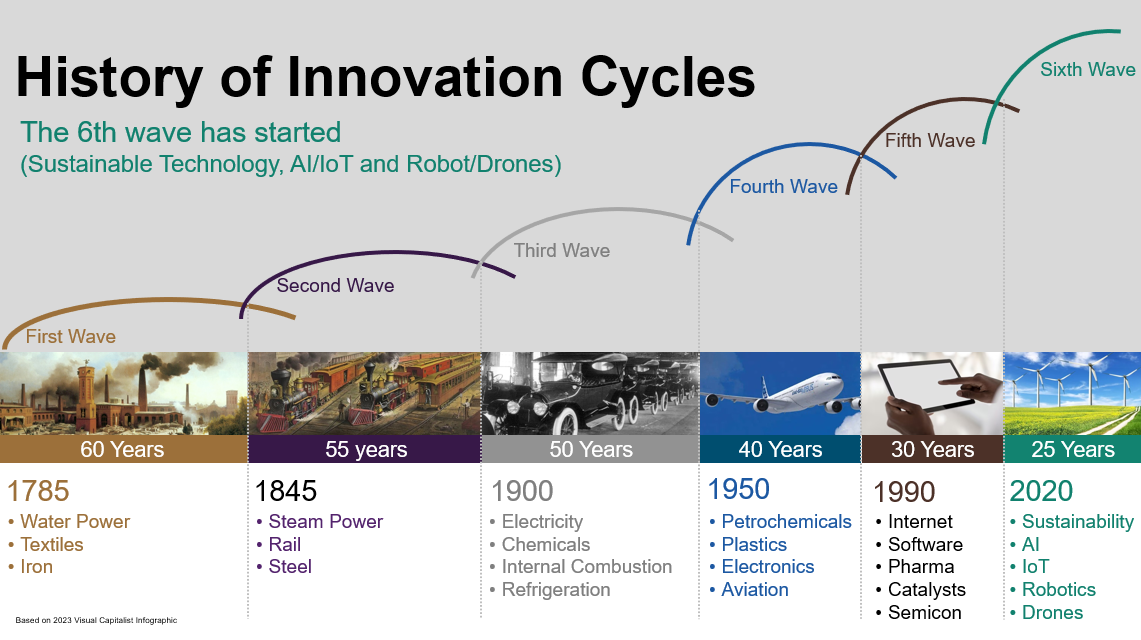
But this wave is different. It’s not driven by a single technology, it’s driven by how well we can integrate across carbon, energy, water, and system-level tradeoffs.
That’s why I believe it’s critical that chemical engineers become fluent in the dimensions of sustainability, what I call carbon fluency. Not just understanding emissions, but knowing how to interpret them, compare options, and make better decisions across products, processes, and value chains.
Because in this sixth wave, the advantage will go to those who can connect disciplines, quantify tradeoffs, and turn complexity into better decisions, and that’s exactly what chemical engineers are trained to do.
After more than 35 years as a chemical engineer, I’ve never been more excited about the potential to solve real-world problems with technology. Having worked across the entire fifth wave of innovation, I see tremendous opportunity for chemical engineers to help revolutionize products and processes between now and 2050.
I’m optimistic about the opportunity ahead for chemical engineers because our ability to think in systems, manage complexity, and scale solutions is exactly what this next wave of innovation requires.