

Industrial biotechnology is becoming increasingly sophisticated, but technical capability is only one part of building a successful product. As the field matures, decisions about scale, cost, manufacturing, infrastructure, and markets are playing an increasingly important role in commercialization.
Commercial viability requires more than successful biology
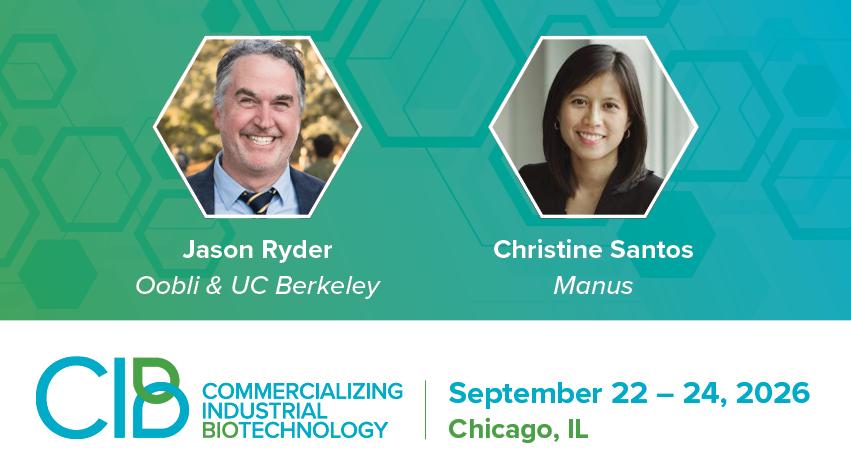
Christine Santos, Co-Chair of the 2026 Commercializing Industrial Biotechnology (CIB) Conference and Chief Technology Officer at Manus, sees the industry’s biggest constraints shifting beyond scientific discovery. “The industry's bottleneck stopped being scientific a while ago,” she says. Today, cost of goods, access to capital, manufacturing infrastructure, feedstock logistics, offtake agreements, and scale can all influence whether a technology ultimately becomes a viable commercial product.
Scale provides one of the clearest examples. Santos points to the question of whether “a process that worked at 100 liters holds up at 200,000 liters.” What works at a smaller scale still has to contend with the engineering and economic realities of commercial production. “Many of the disappointments of the last decade were rarely failures of biology,” she says. “They were failures of engineering, economics, and timing.”
Jason Ryder, CIB Co-Chair, CTO and Co-Founder of Oobli, and Adjunct Professor at the University of California, Berkeley, similarly describes industrial biotechnology as still being relatively early in turning its scientific potential into products that can be produced economically and at scale. Together, their perspectives highlight the range of scientific, engineering, and economic considerations involved in moving industrial biotechnology toward commercial production.
The commercial environment is also evolving
The conditions surrounding commercialization are also changing. Ryder points to AI tools as an opportunity to improve speed, predictability, and commercial success across biotechnology and biomanufacturing, alongside continued advances in synthetic biology, strain engineering, bioprocess engineering, and bioproduction.
At the same time, Ryder says global shifts in investment and supply chains are creating opportunities to revisit infrastructure and feedstocks worldwide. CIB is placing an additional spotlight on the Midwest this year because of the region’s existing biomanufacturing and feedstock base.
Those issues are reflected across the CIB 2026 program. Sessions will examine manufacturing in the Midwest, supply chains spanning feedstock to final product, AI-enabled biomanufacturing, public-private partnerships, synthetic biology, and strategies for profitable biomanufacturing. The program brings many of the technical, economic, and operational considerations involved in commercialization into the same conversation.
Experience can inform better commercialization decisions
The experiences of companies and practitioners that have already confronted the realities of scale-up and commercialization can also offer useful insight into those challenges.
Santos says CIB was built around that need. The conference brings together people responsible for P&Ls and plants as well as those who rely on and use the resulting products. “We ask them to talk about what the decision actually cost, what they'd do differently, what was successful, and where the process nearly (or actually) failed,” she says.
Ryder points to the value of having startups, established companies, investors, researchers, government, and technology providers in the same conversation. Participants work at different stages of technology development, scale-up, and commercialization, and Ryder says bringing those perspectives together creates an opportunity to share best practices and lessons learned across the industry.
The 8th Commercializing Industrial Biotechnology Conference, September 22–24 in Chicago, will bring industry leaders and practitioners together to examine the factors that fuel success and to share practical perspectives on scaling, manufacturing, and commercializing industrial biotechnology. Learn more and register.