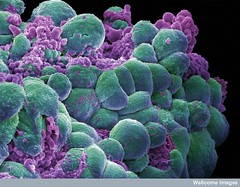
This post is presented by SBE, the Society for Biological Engineering--a global organization of leading engineers and scientists dedicated to advancing the integration of biology with engineering.Breast Cancer Cells. Image by crafty_dame via Flickr
Chemical engineers at MIT have designed a nanoparticle that could one day be used to target cancerous tumors, reports MIT News. The particle, which could be used to deliver drugs to tumors, takes advantage of the fact that tumors generally exhibit higher acidity that healthy tissue. Like other drug-delivering nanoparticles, the researchers' creation is covered in a polymer that keeps it from degrading in the bloodstream. These particles, however, drop their protective polymer cloak once exposed to the higher acidity of a tumor. Underneath the protective coating is another layer that can penetrate the tumor. The particles are described in detail in the journal ACS Nano.
MIT News points out that the researchers behind the technology suggest that the particles could carry virtually any type of drug and could thus be used to target a wide variety of tumors. One of the differences and great advantages of these particles is that most examples of drug-delivering nanoparticles seek out a particular protein, such as those found on a specific type of tumor. The problem seeking out a protein, however, is that a protein that exists only on a tumor--and not on healthy tissue--is often difficult to identify. Furthermore, using a specific protein could easily limit the types of tumors that could be treated, since not all types of tumors would necessarily exhibit the target protein.
More about how the particle works:
The researchers used a technique called "layer-by-layer assembly." This means each layer can be tailored to perform a specific function.
When the outer layer (made of polyethylene glycol, or PEG) breaks down in the tumor's acidic environment, a positively charged middle layer is revealed. That positive charge helps to overcome another obstacle to nanoparticle drug delivery: Once the particles reach a tumor, it's difficult to get them to enter the cells. Particles with a positive charge can penetrate the negatively charged cell membrane, but such particles can't be injected into the body without a "cloak" of some kind because they would also destroy healthy tissues.
The nanoparticles' innermost layer can be a polymer that carries a cancer drug, or a quantum dot that could be used for imaging, or virtually anything else that the designer might want to deliver, says Hammond, who is the Bayer Professor of Chemical Engineering at MIT.
The article reports that the researchers plan to develop their work and also hope to test the particles for drug delivery in animals. The researchers expect it will take five to 10 ten years before trials could begin on humans.
This series highlights the learning that new ChE professionals need that isn’t taught in school. They’ll describe the types of responsibilities they've had in their work to date, as well as the skills or expertise they needed or had to learn that go beyond what they learned as students. You’ll also hear from their mentor or a senior person offering their perspective on the skills or expertise that new professionals must learn.
With lots and lots of business topics open for discussion, this series will focus on Engineering Economics. It will help answer questions you've heard your boss ask, such as: How much will it cost? What will our savings be? Can you show me the cost/benefit analysis? What is the budget for that project?
Meet the 2025 SBE award recipients — Daniel G. Anderson, Karmella A. Haynes, and Costas D. Maranas — and explore their groundbreaking research shaping the future of biological engineering.
Check out AIChE's newest member benefit, AIChE Engage. Use the
robust directory search to find and connect with members.
Participate in technical, career, and academic discussions about
chemical engineering.


 This post is presented by SBE, the Society for Biological Engineering--a global organization of leading engineers and scientists dedicated to advancing the integration of biology with engineering.