

Around the world, the need for fresh, drinkable water continues to grow. From dwindling aquifers to desertification due to climate change to increased demand from expanding data centers, the strain on water systems is seen in communities from Los Angeles to Timbuktu. In response, scientists have investigated a variety of water conservation strategies with a high premium placed on any technology that could efficiently generate water in arid regions. One of those technologies is atmospheric water harvesting (AWH).
Humans have been capturing water from humid air since the Incan Empire, when mesh nets were used to collect dew. However, outside of science fiction, the development of advanced AWH systems has been difficult because of the challenging material properties required of the air filters, which must be able to absorb large amounts of water and readily expel it when needed. They have to function in low humidity, and, ideally, they should be usable off-grid. This is where California-based start-up Atoco comes in.
Atoco was founded in 2021 by Nobel Laureate Omar Yaghi, a chemistry professor at the Univ. of California, Berkeley, to commercialize his breakthrough technologies in molecularly engineered reticular materials for AWH and carbon capture. Since then, Atoco has developed sophisticated nanoengineered reticular materials such as metal-organic frameworks (MOFs) — porous crystalline metallic and organic structures with extremely high internal surface areas — which are capable of adsorbing and expelling water and carbon dioxide. The company has produced on-grid AWH systems, as well as off-grid models that can harvest water using ambient thermal energy. Atoco is currently planning field tests of its containerized industrial prototype AWH units, which it hopes will lead to commercialization in late 2026.
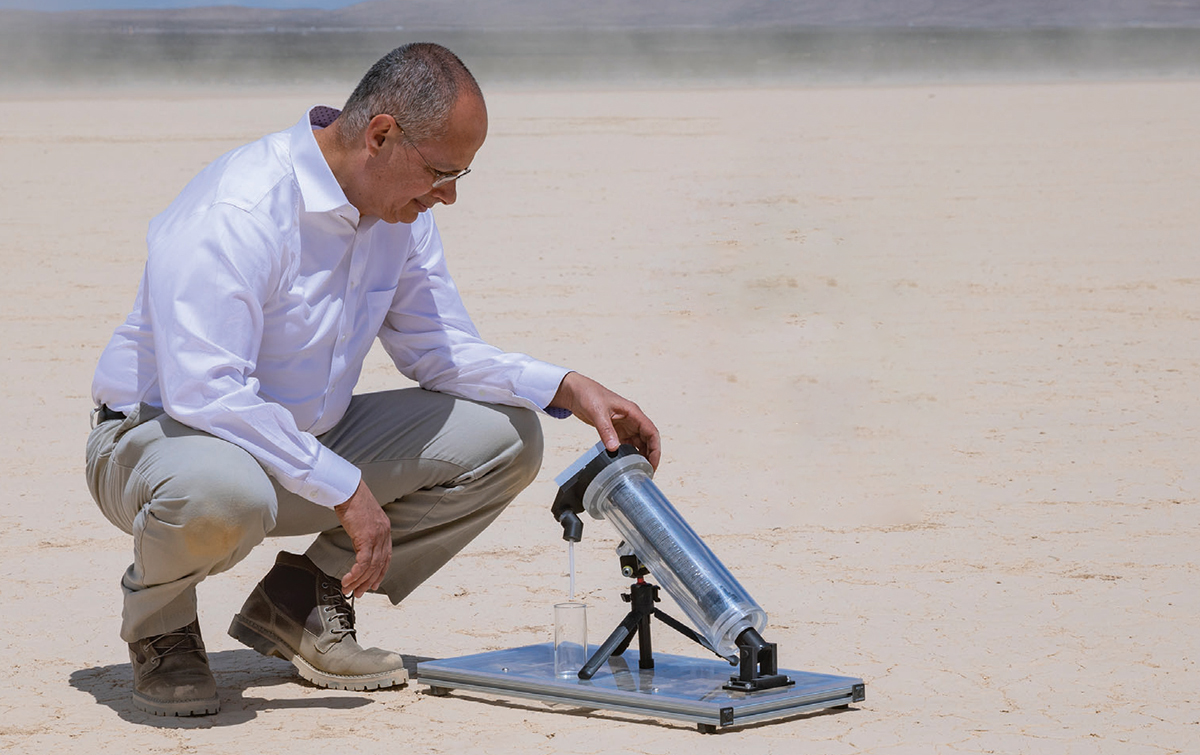
In a conversation with Atoco’s Vice President of Business Development, Magnus Bach, he talks about why he began his work with reticular materials, the current state of Atoco’s technology, and the future of AWH.
What first got you interested in Atoco’s technology?
Bach: Firstly, it’s the properties of the core technology itself. It’s just incredibly interesting and mind-boggling. Take, for instance, a “sugar-cube” of our MOF material. From the outside, this 1 g MOF cube would have a surface area of around 1 m2/g. Due to the extreme nanoscale porosity of the material, however, the internal surface area would be more than 7,000 m2/g — that corresponds roughly to a soccer field per gram. The fact that the material contains so much surface area is the key to understanding its exciting properties, because the more surface area you have, the more “molecular parking lots” are available for molecules to be adsorbed. Interestingly enough, the technology itself is considered solid-state, so even if the materials are saturated with water at a molecular level, it still looks dry to the naked eye.
Secondly, the fact that reticular materials enabled entirely passive water generation was intriguing. If you think of it, the possibilities are endless. If you can generate pure water without electricity, powered entirely by free ambient energy, even in arid and dry environments with low relative humidity (RH), then you can produce water in the desert to fight desertification or support desert farming practices. Or, you can use the waste heat from a mission-critical data center or an industrial process to produce water for cooling. It sounds like magic, but the reality is that it is hard science and, soon, also a fully commercialized product.
Atoco employs adsorption-based AWH systems rather than condensation or desiccant systems. What are the differences between these systems, and what are the advantages of adsorption?
Bach: We are not building on existing approaches to atmospheric water harvesting, as they have inherent challenges, especially in the applications and use cases we are targeting. Incremental improvements on cooling-condensation-based technologies would simply not get us to where we need to be in terms of generation capacity, energy efficiency, and climatic envelope.
Cooling-condensation-based solutions work by reducing the temperature to the dew point at which the humidity in the air condenses. Sometimes, that means reducing the temperature by 25°C–30°C, meaning you are essentially refrigerating ambient air. Naturally, this is incredibly energy-intensive, especially if the RH is low. The reality is that cooling-condensation-based AWH solutions cease to generate water at RHs below 30%–35%. As a rule of thumb, the lower the RH, the higher the kWh per liter generated, until it ceases generating water altogether. This fundamental design challenge constrains the applications you can target, as you can really only target humid conditions where electricity is available and not too costly.
Wet-desiccant-based AWH solutions work better in lower RH environments, but here, the challenge again is related to energy efficiency. Desiccants easily take in water molecules, but tie the water molecules to the material through strong bonding that takes a lot of energy — in the form of heat — to break. So instead of cooling the air, with desiccants, you are forced to heat the materials to desorb the water molecules from them. This is, again, a highly energy-intensive process that constrains its practical applications.
For Atoco, relying on reticular materials allows us to entirely rethink AWH solutions. We will still have to move humid air through a process, but the selectivity by which we can capture such molecules, the humidity at which we can harvest such molecules, and the energy consumed when doing so are optimized significantly [in adsorption systems].
What are the benefits of having on-grid and off-grid technologies, and how do the applications differ?
Bach: The water-generation capacity of a given AWH system is influenced by several factors — in particular, climatic conditions such as temperature and relative humidity. Ultimately, you want to increase the number of adsorb-desorb cycles you can run per day, as more cycles — everything else being equal — increase the generation capacity. In the case of Atoco’s AWH solutions, our on-grid solutions run more cycles than our off-grid solutions, enabling an energy-efficient generation capacity of up to 2,000 L to 4,000 L per day, depending on climatic conditions. In comparison, our off-grid AWH solutions can generate up to 1,000 L of clean water per day, but without any electricity consumption whatsoever, powered entirely by ambient energy.
If we take a closer look at Atoco’s off-grid AWH solutions, the generation process is 100% powered by the temperature difference between a warm and a cool source of ambient energy, the delta being as low as 7°C. If we have a stable supply of low-grade heat, for instance, we can ensure a stable supply of clean water without consuming any electricity at all. If we are at remote locations, we can tap into geothermal heat to power the generation process. If we are at industrial facilities, we can tap into low-grade waste heat, even at temperatures as low as 50°C. The latter is an incredibly powerful feature. Worldwide, approximately 70% of industrial waste heat is considered low-grade or ultra-low-grade. Atoco’s technology can tap into this massive, underutilized energy source to generate water sustainably. We use “free” energy to produce water from a source that is completely untapped, and we can do that at utility scale. Ultimately, one ton of Atoco’s AWH reticular material, based on Professor Yaghi’s latest discoveries, can produce up to 20 tons of clean water per day when deployed in Atoco’s custom-built off-grid AWH solutions. Incumbent technologies simply cannot scale to such levels.
What do you see for the future of your technology?
Bach: The properties of our solutions and the scale at which we can deploy them can have a significant impact on several sectors. Data centers, depending on their cooling systems, consume a lot of water, and with the artificial intelligence (AI) revolution taking place, this will increasingly be a challenge, especially in areas already suffering from water stress, such as the U.S. Southwest. The interesting thing is, of course, that they have all the ambient energy in the world in the form of waste heat. The point is that Atoco’s technology can “eat the heat” to produce water that can then be fed back into the cooling systems. We would be transforming waste heat into valuable on-site water that can be fed into the cooling processes as makeup water, thereby reducing overall water consumption.
Another example is to rely on AWH solutions to provide clean water as a feedstock for green hydrogen production. Today, through electrolysis, green hydrogen production often relies on surface or groundwater, sourced from nearby wells or transported over long distances. The purity of the water is far from sufficient to meet the standards required by electrolyzers. Leveraging Atoco’s AWH solutions, however, we can use the heat from the electrolyzer to run the generation process, thereby producing water on-site at a purity similar to distilled water.
What prospective applications do you foresee for AWH technology in the future beyond its current uses?
Bach: The technology is yet to be commercialized, but there is no doubt that the technology has a significant potential to mitigate water scarcity and stress, not least due to the fact that it can operate at utility scale while powered entirely by ambient energy. That is transformative, because — much like what we have seen in the energy system where power generation is decentralized by using photovoltaics (PV) and wind turbines — we can decentralize and democratize water generation. By doing so, we will make the water system much more resilient in the face of disruption. If electricity is down and roads are blocked, an off-grid system still produces water. Ultimately, that can save lives.
This article originally appeared in the ChE Spotlight column in the December 2025 issue of CEP. Members have access online to complete issues, including a vast, searchable archive of back-issues found at www.aiche.org/cep.