

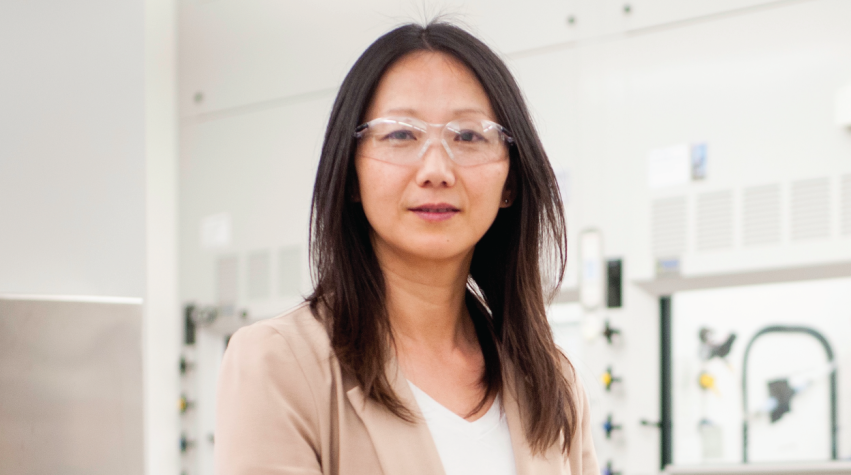
The skin is the largest organ of the human body, covering roughly 20 ft2 for the average adult. It is a sophisticated sensory network, capable of delivering our sense of pressure, temperature, and texture to our brains. As the body’s primary interface with the physical world, it serves as a blueprint for the next evolution of electronics in healthcare. As a chemical engineering professor at Stanford University, Zhenan Bao has spent decades investigating the boundary between human and machine with her research.
From chemistry to chemical engineering
Bao’s academic roots are in chemistry, not engineering. “I’m not a traditional chemical engineer,” she says. “I was trained as a chemist throughout my undergraduate and graduate studies.” Her passion was ignited early by her mother, who was a chemist. She would show her how pH paper would change color, which fascinated Bao. She was also intrigued by the idea of being able to create new substances.
Following her PhD in chemistry from the University of Chicago, Bao pivoted into industry, joining Bell Labs, where she developed flexible screens for electronic displays. In retrospect, she considers it a foundational chapter in her professional life, exposing her to interdisciplinary research and high-stakes problem-solving. “I think going to Bell Labs was one of the best decisions I’ve made in my career,” Bao recalls, as they offered rigorous mentorship and a culture that balanced support with critique.
The early 2000s saw the burst of the internet bubble. Bao realized that deep, fundamental research requires stability that fluctuating markets often cannot guarantee. In addition, she always enjoyed discussing science and interacting with students. As a result, Stanford became her natural home, where she began teaching chemical engineering.
Reimagining electronic skin
At Stanford, Bao pivoted from flexible displays toward a more visionary goal: electronic skin (e-skin). A few research groups have worked on e-skin before Bao, but they approached it from the electrical engineering side. While electrical engineers tried to force silicon and metal to mimic skin using physical tricks like spring patterns or cracks, Bao approached the problem from the molecule up. “I thought that electronic skin should actually be like human skin,” she says. “They should be stretchable and self-healable and biodegradable.”
Her team encountered a challenge: polymers need to be disordered to stretch, but electrical charges require rigid, planar structures to transport efficiently. “Having these rigid planar molecules makes the semiconducting polymer very rigid and brittle,” Bao explains. Their breakthrough came with nanoconfinement strategies. By organizing molecules into rigid boundaries within a stretchable matrix, they created a “fishnet” structure where charge transport remains excellent even as the material stretches. As a result, this molecular engineering allowed e-skin to contain integrated circuits and sensors that can sense pressure, chemicals, and biological signals like heartbeats on a single monolithic sheet.
The skin-inspired approach also enabled self-healing properties. At the molecular level, reversible chemical bonds allow molecules within the material to move and seal gaps when triggered by heat or light.
While e-skin holds immense promise for prosthetics, Bao acknowledges the hurdles in integrating such technology with the nervous system. E-skin can convey basic sensations like pressure or temperature via stimulation, but restoring full touch over the length of an entire limb remains complex. “We don’t have enough nerves to be connected. It’s very challenging to have the sensor connect to the right nerve,” she says. However, in robotics, e-skin is already enhancing safety and precision. When paired with artificial intelligence (AI), robots equipped with this sensory feedback can handle delicate objects safely and react instantly to physical contact.
Bringing e-skin beyond the lab
As the capabilities of her materials expanded, Bao recognized a need for interdisciplinary collaboration and founded the Stanford Wearable Electronics Initiative in 2016, now known as eWEAR-X. The initiative bridges silos between engineering, medicine, AI, and robotics. With involvement from over 10 departments, eWEAR-X supports translational efforts through a prototyping lab sponsored by the Tianqiao and Chrissy Chen Institute. “The goal is really to connect, enable, and also empower the community,” Bao emphasizes.
Bao’s vision is ultimately defined by patient impact. Despite her commitment to fundamental science, she is driven to get products into clinical use. Her lab has already achieved significant translational milestones. One e-skin application is now an FDA-approved device used in hospitals for infants, providing comfortable blood pressure monitoring as a replacement for the traditional cuff-based method. “We have used the e-skin to just gently wrap around the arm for continuous blood pressure monitoring,” Bao notes. The team is now expanding this technology for broader adult usage.
Zhenan Bao has consistently followed her strengths in chemical and molecular engineering to solve problems that impact everyday lives. As she continues to push boundaries while bringing her creations closer to clinical reality, she is crafting a future where technology feels as natural and responsive as our own human skin.
This article originally appeared in the Profile column in the June 2026 issue of CEP. Members have access online to complete issues, including a vast, searchable archive of back-issues found at www.aiche.org/cep. Learn more about AIChE membership.