


Process safety education plays a critical role at every stage of an engineer’s career. In this three-part series, experts from the Center for Chemical Process Safety (CCPS) explore how engineers can build and strengthen the knowledge, judgment, and habits needed to manage risk and support safer operations.
Below, Louisa A. Nara, CCPSC, CCPS Fellow, CCPS Emeritus, and former Global Technical Director of CCPS, explains in part one of this series why process safety should be treated as a core engineering competency from day one. She also addresses common misconceptions among early-career engineers and highlights how the CCPS Fundamentals Certificate Program can help establish a strong foundation.
Process safety isn’t a specialty reserved for certain job titles; it’s an essential engineering discipline. I’ve seen this across decades of work in operations, leadership, and incident learning. Engineers who grow into trusted leaders understand early that every decision influences how hazards are managed and how safely a facility operates.
That’s why process safety understanding must begin early, long before an engineer is formally assigned to a PSM-covered unit or a risk-focused role. It’s foundational to the CCPS Vision: A World Without Process Safety Incidents.
Why early exposure matters
Early-career engineers make thousands of decisions — about materials, operating limits, equipment tolerances, controls, and procedures. Most feel small at the time, but they accumulate. They shape operational discipline. They influence risk. They determine whether safeguards stay strong or quietly erode.
In recent reflections on LinkedIn and CEP’s Spotlight on Safety, I’ve talked about the importance of clear sight — the ability to see weak signals, subtle shifts, and emerging risks before they become problems. That clarity doesn’t come from experience alone. It comes from learning process safety principles early, when habits are forming and judgment is still being shaped.
Common misconceptions among engineers
New engineers often arrive with misconceptions that unintentionally narrow their perspective:
- ”Process safety only applies to chemical plants.” Any facility handling hazardous energy or materials relies on process safety principles, from food processing and pharmaceuticals to energy production, nuclear, mining, and aviation.
- ”The PSM team owns process safety.” Specialists provide structure and tools, but frontline engineers make the daily decisions that determine risk. Process safety is everyone’s job.
- ”Process safety is mostly about compliance.” Compliance is the minimum. CCPS promotes best practices that elevate operations, safety, and efficiency. True process safety means understanding hazards, designing resilient systems, and preventing catastrophic events.
- ”I’ll learn process safety later when I need it.” By the time an engineer realizes they “need it,” they’ve already made decisions that affect risk.
These misconceptions surfaced in my recent LinkedIn post welcoming new engineers into the profession. Many enter the workforce technically capable but may not yet recognize how strongly their judgment influences safety, reliability, and long-term asset performance.
How a strong foundation builds better engineers
Engineers with a strong grounding in process safety think differently. They see systems holistically. They anticipate failure modes. They understand how design, operations, and human factors interact.
This perspective builds the confidence required to challenge assumptions, to speak up when something doesn’t look right, and to balance innovation with risk. It’s what turns engineers into leaders.
And it aligns with a leadership principle I often share: See it. Own it. Act on it™. Process safety teaches engineers to see what others miss, own their role in managing risk, and act decisively to protect people and operations.
This is how engineering judgment is shaped and leadership begins. It’s also the foundation of the CCPS Fundamentals Certificate Program.
How the CCPS Fundamentals Certificate Program helps
For engineers looking to strengthen their foundation, the CCPS Fundamentals Certificate Program offers a structured, accessible starting point. It introduces essential concepts: hazard identification, risk analysis, layers of protection, human factors, and the behaviors that support a strong safety culture.
Participants gain competence and confidence. They learn why process safety matters, how incidents happen, and what they can do to prevent them. The program builds a foundation that supports engineers throughout their careers, regardless of industry or role.
For organizations, it creates a common language and baseline capability across engineering teams, strengthening decision-making, improving collaboration, and supporting operational excellence.
Why this matters
Every engineer who builds this foundation early becomes part of the solution: someone who sees risk clearly, owns their decisions, and acts to protect the people and operations they serve. That's how we move toward a world without process safety incidents.
For more reflections on process safety, operational discipline, and engineering leadership, follow Louisa on LinkedIn.
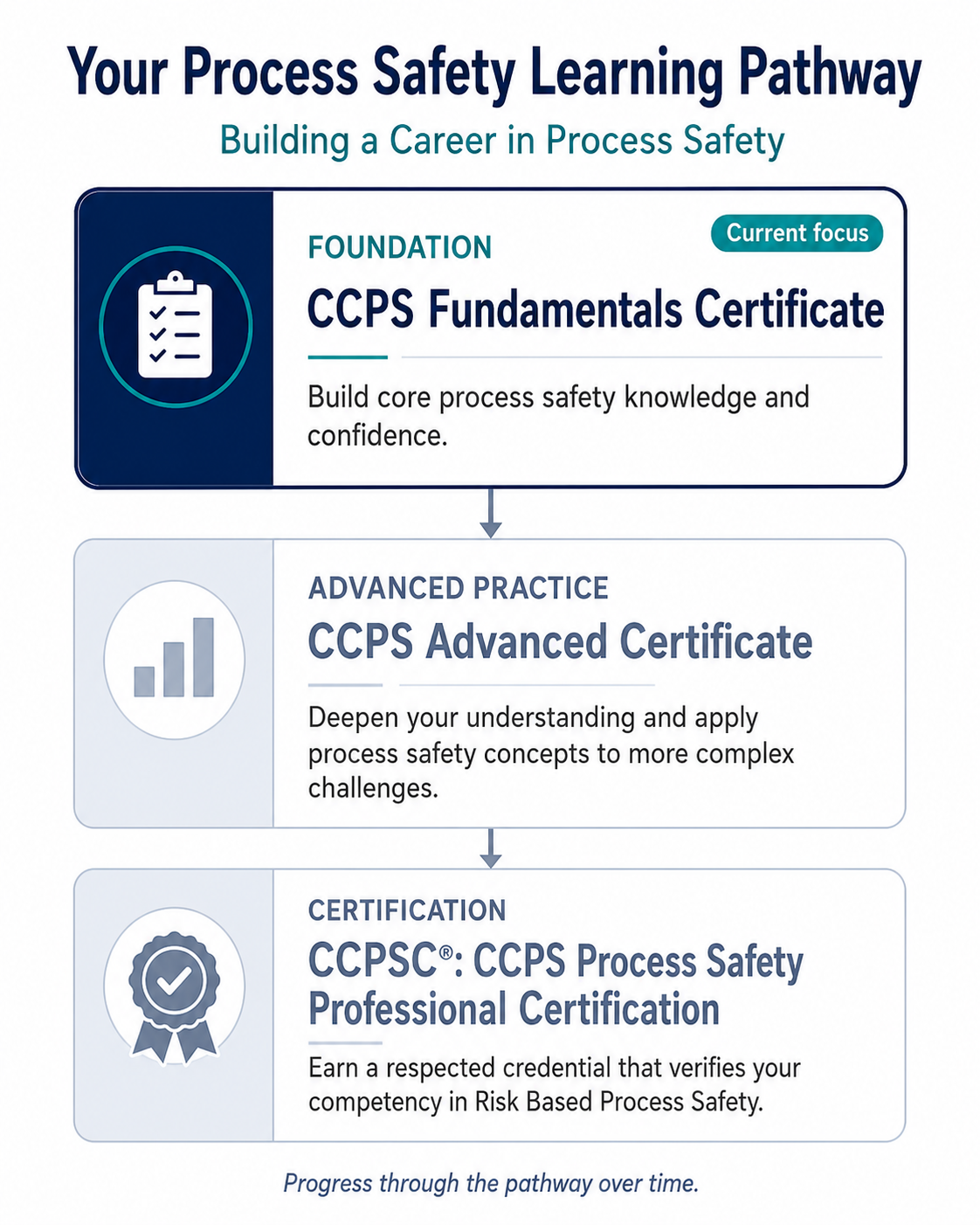
Learn more about the CCPS Process Safety Fundamentals Certificate Program