

Gene editing and RNA technologies are opening new possibilities for treating disease. Recent advances, including the first personalized CRISPR gene therapy and increasingly sophisticated RNA-based medicines, demonstrate how quickly the field is progressing. But as these technologies move closer to patients, another challenge is becoming more pressing: turning promising science into medicines that can be delivered, manufactured, and used safely.
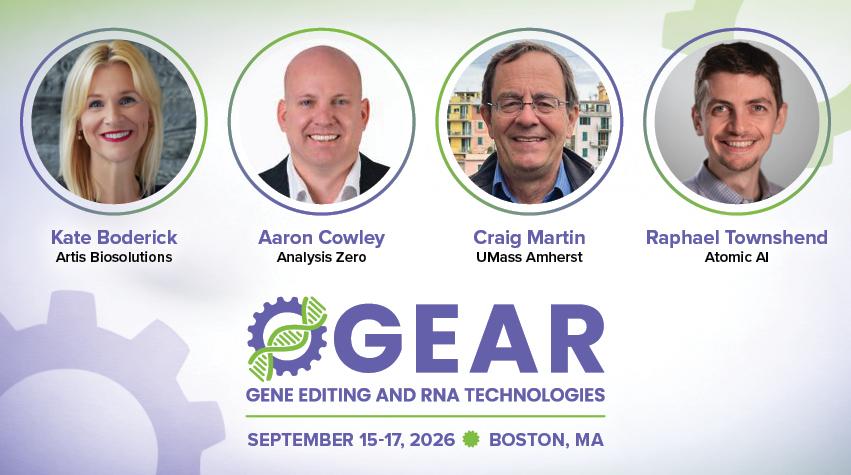
Ahead of the 2026 Gene Editing and RNA Technologies (GEAR) Conference, ChEnected spoke with four speakers from across the program. Drawing on their expertise in gene editing, RNA technologies, manufacturing, and computational biology, they discussed the barriers that can emerge during development and why addressing them earlier could help promising treatments reach patients.
Better tools still need better delivery
Laura Sepp-Lorenzino, Biotech Executive at GNMmeds LLC, sees significant potential in the convergence of RNA technologies and genome editing. She points to RNA medicines’ ability to support increasingly sophisticated therapeutics alongside the potential for genome editing to offer a one-time intervention. Aaron Cowley, Chief Scientific Officer at Analysis Zero, sees personalized CRISPR as another important sign of progress.
Both identify delivery as a major challenge as these technologies advance. “We have powerful molecular tools, but their impact will ultimately depend on our ability to deliver them safely, efficiently, and selectively to the right cells and tissues,” Sepp-Lorenzino says. Cowley adds that success with in vivo delivery remains concentrated in targets such as the liver and blood stem cells, and that achieving safe, tissue-specific delivery remains a core constraint.
The result is a gap between what researchers can design and where those technologies can currently go in the body. Closing that gap could expand the range of diseases that gene editing and RNA technologies can address.
Solving delivery is only part of the challenge
Reaching the right cells and tissues is critical, but another issue is even more important: the right biological target. “The best delivery system or editing tool cannot rescue the wrong biological hypothesis,” Sepp-Lorenzino points out, adding that RNA therapeutics can be particularly useful for validating targets and mechanisms before committing to a permanent genome-editing intervention.
Production introduces another set of considerations. Craig Martin, Professor at the University of Massachusetts Amherst and Co-founder and CEO of Waterfall Scientific, a UMass spin-out company, points to double-stranded RNA, or dsRNA, impurities that can emerge during RNA manufacturing. He also notes that the significance of these impurities depends on the application, but reducing them can require additional purification steps that would not be necessary if the impurity were not produced in the first place.
Manufacturing strategy can create similar obstacles later in development. Kate Broderick, Chief Science and Innovation Officer at Artis Biosolutions, says developers can, understandably, prioritize science and product development while giving less attention to manufacturing. But she cautions that choices about manufacturing partners and timelines can have significant consequences when a therapy is ready to move toward the clinic.
Personalized gene editing complicates manufacturing further. Cowley says the challenge may be less about traditional scale-up and more about “scaling out,” or reliably and cost-effectively producing thousands of individualized “batches of one.” He sees automation as essential to making that model feasible.
These are also engineering challenges. Purification, process control, automation, quality assurance, and reproducible manufacturing will help determine whether individualized treatments can move beyond isolated successes and reach patients more broadly.
Taken together, these challenges show why translation cannot simply begin once researchers have proven that a technology works. Decisions about the biological target, delivery, production process, and manufacturing strategy can each influence whether promising science progresses toward a medicine.
Translation needs to start earlier
Addressing those challenges requires expertise across disciplines. For Raphael Townshend, Founder and CEO of Atomic AI, the data supporting emerging RNA technologies offer one example. Townshend says machine learning approaches depend on relevant, high-quality data, yet gaps remain in foundational datasets around RNA structure and function. He sees a need for academia and industry to identify the most important data gaps and develop coordinated approaches to addressing them.
Sepp-Lorenzino sees the same need for integration across the broader development process. “The greatest need is around translation,” she says. “We need tighter collaboration between those developing the underlying biology and technologies and those thinking about manufacturing, delivery, safety, and clinical development.”
Together, these perspectives point to a broader shift in how gene editing and RNA medicines are developed. Translation cannot wait until a technology has already demonstrated scientific promise. Questions involving biological targets, delivery, data, safety, purification, automation, manufacturing, and clinical development need to be considered from the beginning.
Doing so requires closer collaboration among biologists, engineers, data scientists, manufacturers, and clinicians. The scientific tools are advancing quickly. Whether they become viable medicines will depend on how effectively these disciplines work together to solve the practical challenges surrounding them.
These challenges will be part of the conversation at the 2026 Gene Editing and RNA Technologies (GEAR) Conference, September 15–17 at the Auditorium at Merck Research Laboratories in Boston. The program covers gene editing, targeted delivery, vaccines, RNA technologies, manufacturing, and the use of AI and machine learning in RNA therapeutic development.