

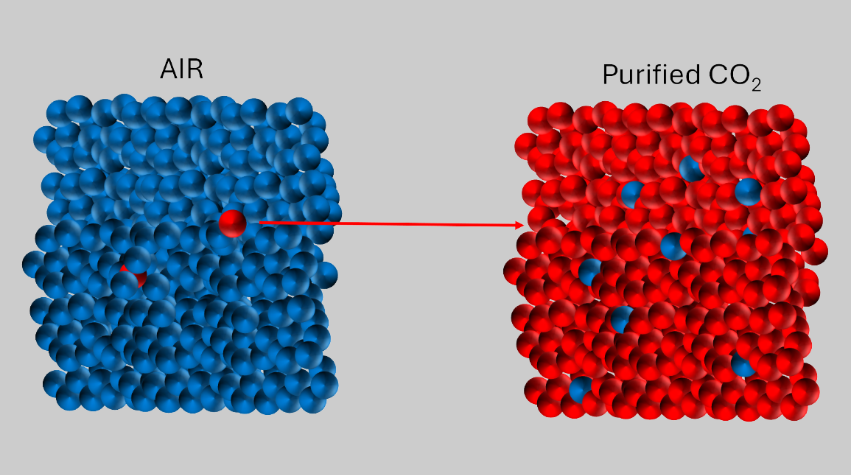

The graphic above illustrates the separation of 0.04% CO2 (red) from air (blue) and its purification to 95% purity.
Disclosure: This post is sponsored by ExxonMobil and reflects their views, opinions, and insights.
The Q&A below is with Ben Marshall, a thermodynamicist leading a technology research program focused on direct air capture (DAC) for ExxonMobil. One of Ben’s passions is energy. Not the kind that his kids would have after eating a sweet treat, but the energy that drives all chemical, mechanical, and electrical processes needed to capture carbon dioxide from the atmosphere. When it comes to designing a low-energy DAC process, knowing the laws of thermodynamics isn’t enough. It takes a careful, dedicated balance of where to expend precious energy.
Why is energy so important for direct air capture (DAC)?
Direct air capture goes beyond simply removing CO2 from the air. The goal is to deliver CO2 at concentrations greater than 95%—a requirement that enables cost-effective CO2 transport and storage. The energy per molecule required to remove diluted CO2 from the air and deliver it in a concentrated form goes up as its concentration goes down. Capturing CO2 directly is three to five times more energy-intensive than capturing it from a factory or power plant exhaust stream. Air contains only 0.04% CO2 while a gas turbine’s exhaust contains at least 4% CO2 (100 times higher).
The main goal of DAC is to remove CO2 from the air using the least amount of energy possible. DAC systems use a material that grabs CO2 from the air. Similar to a sponge, when the material is saturated, energy is required to remove and collect the CO2. The active material is then reused to capture more CO2.
How does the choice of DAC system design affect the energy required?
Several types of DAC technologies are being developed. One approach uses a liquid chemical solution called potassium hydroxide (KOH) to pull CO2 from the air in large collectors. Once full of CO2, the solution must be heated to very high temperatures (about 900°C) or treated with electricity to release the CO2 and reuse the solution.
Another common DAC approach uses solid materials called amines arranged in a honeycomb-like structure. As air flows through the material, the amines capture CO2, much like a vacuum cleaner’s filter. When full, the material can be regenerated and used again by heating it to lower temperatures, around 100°C.
Because amine systems require lower temperatures, they can often use less expensive energy sources. Interestingly, while some KOH-based systems require higher temperatures, they may actually need less energy overall to regenerate the captured material.
What is one of the key challenges to minimize energy for DAC?
When considering a DAC system, it's important to consider three critical factors: how much energy it uses, how much it costs, and where the energy comes from.
DAC systems that need only low-temperature heat can utilize heat from factories or energy from nuclear or geothermal sources. Since this heat can't easily be converted to electricity anyway, using it for DAC offers a practical way to remove CO2 from the air.
What role could DAC play in broader decarbonization efforts?
Direct air capture has the potential to play an important role in decarbonization strategies as it aims to remove CO2 emissions and could enable the decarbonization of hard-to-abate emissions, where direct carbon capture isn't currently practical. However, removing CO2 from the air is challenging from both a capital cost and an energy use perspective. The scale to which DAC systems will be deployed ultimately depends on its cost and energy intensity. If costs and energy requirements can be reduced significantly, DAC could help address emissions that are difficult to reduce through other means.
This DAC challenge will focus on reducing energy use in existing DAC processes or developing new DAC concepts and designs. Are you up to the challenge?
Learn more about Direct Air Capture.
Join us at the ChemE Cube™ Competition in Minneapolis to watch teams compete in the direct-air capture challenge November 8th-9th.

Ben Marshall
Ben Marshall is a thermodynamicist who is leading a technology research program focused on direct air capture (DAC) for ExxonMobil. Learn more.
Disclosure: This post is sponsored by ExxonMobil and reflects their views, opinions, and insights.