
For Allison Pieja, methane is more than a greenhouse gas — it’s an untapped resource. As cofounder of California-based biotech company Mango Materials, she has helped pioneer a biological process that feeds methane to naturally occurring bacteria, which convert the gas into biodegradable polymers that can replace conventional plastics in a growing range of applications.
Methane is often viewed as an environmental liability. However, by sourcing methane from places such as wastewater treatment plants, landfills, and agricultural operations, the company aims to reduce emissions while creating materials designed to return safely to the environment at the end of their useful life. Mango Materials employs methane-consuming bacteria that store energy by accumulating polyhydroxyalkanoate (PHA) biopolymer granules within their cell walls that can later be harvested and transformed into sustainable consumer products. The company’s biopolymer has been integrated into a soap dish for Natura, Allbirds’ shoes, and Stella McCartney promotional sunglasses that were presented at the 28th United Nations Climate Change Conference (COP28). The biotech company also sells their own set of sandbox toys, allowing them to enter the market directly, educate children, and communicate their story to customers. They are also launching a direct-to-consumer 3D-printing filament and have fiber and film grades in development.
Drawing on a background in environmental engineering from Princeton University and Stanford University, Pieja leveraged her experience to successfully translate academic research to commercial products. In this interview, she discusses the science, the scale-up challenges, and the future of methane-derived materials.
What first inspired you to found Mango Materials?
At Stanford, I studied the production of the biopolymer PHA from methane gas, and one of my cofounders — Molly Morse, our current CEO — studied the biodegradation of PHA into methane gas. Together, we covered the full circle. I have always been interested in science and engineering, and before my senior year in college, I decided I wanted to spend my scientific career focused on technologies that benefit the environment.
When Molly and I were in grad school at Stanford together, we would always half-joke about starting a company. As we neared the end of our PhDs, we started seeing some interest from venture capitalists (VCs) in our work. After graduating, Molly consulted for a VC firm, doing technical diligence on other start-ups, and we realized that the other founders were no different from us. At that point, we joined with a third cofounder, Anne Schauer-Gimenez, and founded the company.
Mango Materials specializes in using microbial processes to convert methane emissions into biopolymers. What benefits do biobased processes provide over catalytic processes?
We are advocates of using processes developed by nature whenever possible. Compared to chemical processes, which often require many steps and more extreme conditions (e.g., high temperatures and pressures), biological processes are often done in a single unit operation and at much more moderate conditions. Biological processes are also frequently much more targeted, can handle heterogenous/mixed/waste feedstocks, and are capable of producing a specific product, with fewer unwanted byproducts.
Captured methane emissions have been used for a variety of applications, like green electricity and renewable natural gas. What is the unique value of using this feedstock for bioplastics?
While we support the use of methane for applications such as power or natural gas generation, we believe that the highest and best use of it is for products, to support a regenerative bioeconomy. There exist many alternative environmentally friendly ways to generate electricity, but carbon will always be required to produce materials such as plastic replacements. The use of methane to produce biopolymers displaces the use of petrochemicals. When methane is used to produce biopolymers like PHA, that carbon is stored in the product over its useful life, and when the product does biodegrade, the carbon returns to the environment slowly and naturally.
How have considerations of end-of-life disposal and biodegradability influenced the development of your technology?
We have always been driven by the goal of producing a plastic replacement that is truly biodegradable and designed for its end of life. Like many others, we have been influenced by iconic images of plastics on far-flung, remote beaches, in the stomachs of wildlife, and in the Great Pacific Garbage Patch. PHA will break down — by naturally occurring enzymes — under a wide variety of conditions, with and without oxygen present, in facilities such as wastewater treatment plants, landfills, and industrial or home compost, as well as in environments such as soils, freshwater, and seawater. We wanted to create products that would enter the naturally occurring carbon cycle if they are accidentally disposed of in nature, and we wanted a material that would not produce toxic microplastics.
We are aware that many parts of the world do not have dedicated waste collection for compostables and/or do not currently accept bioplastics such as PHA. As we develop products, we have worked with groups interested in piggybacking on existing takeback programs such as in high-end cosmetic products, where PHA-based cosmetic packaging could be collected and properly disposed of. We are also currently focused on what we term “environmental products,” where biodegradability plays a key advantage and may even be required. For example, we currently supply material for ArborStakes, a company that produces tree stakes to stabilize young, growing trees. The use of biodegradable PHA eliminates the costly need to have personnel go back and collect the tree stakes at the end of their useful life. Ultimately, even if PHA products wind up in landfills, they will break down, preventing the further accumulation of plastic waste on our planet.
What have been the biggest challenges in bringing methane-derived bioplastics toward commercialization?
Where do we begin! The challenges have certainly shifted over time. When we started Mango Materials, just convincing people that plastics and methane emissions were problems was a challenge. I would say the biggest challenge is what I call the “chicken-and-egg” problem: To demonstrate market traction, you need to produce product. To produce product, you need to scale your technology, which requires funding. To raise funding, you need to demonstrate market traction.
We’ve taken a few key steps to break out of this spiral. For one, we’ve made efforts to scale our technology quickly and as inexpensively (but safely) as possible. Rather than opting for top-of-the-line systems that plan for every scenario and can monitor every variable online, we’ve opted for less expensive but functional systems that might require more manual monitoring but still get the job done. We’ve combined this with a healthy dose of do-it-yourself-ness — our first, 500-L system was built and programmed almost entirely by our own team and included many off-the-shelf parts rather than specialized equipment. This has allowed us to scale more cost-effectively and quickly, which has allowed us to produce product samples for commercial markets as well as demonstrate to partners and investors that we have a real, physical technology.
The second thing we’ve done to break out of the aforementioned spiral is to do product development work with plant-based PHA, which is functionally identical to methane-based but is currently more easily produced from established sugar fermentation. Using plant-based PHA has allowed us to develop deep expertise in polymer processing and to create a number of different product grades, for applications ranging from injection molding to 3D printing to fibers to films.
What do you see as the long-term vision for Mango Materials and for biodegradable plastics more broadly?
Our dream goal at Mango Materials is simple — to see a billion pounds of PHA produced for world markets. Our vision is a truly circular economy, where plastics used for short-lived products come from waste gases rather than ancient fossil fuels, and return safely to the environment when they’re done. We see facilities like landfills and wastewater treatment plants evolving into resource hubs, where waste becomes the starting point for useful materials. More broadly, we want to demonstrate that solving climate problems and making products people actually want to buy aren’t competing goals. For the biomaterials industry as a whole, there is an enormous opportunity: Most plastic products don’t actually need to last forever, even though almost all of them do. The future we’re working toward is one where using a carbon-negative, environmentally friendly material that returns to the earth when no longer needed is simply the default, not the exception.

Allison Pieja
Allison Pieja is a cofounder of Mango Materials, a California-based biotechnology company that converts methane into biodegradable polymers.
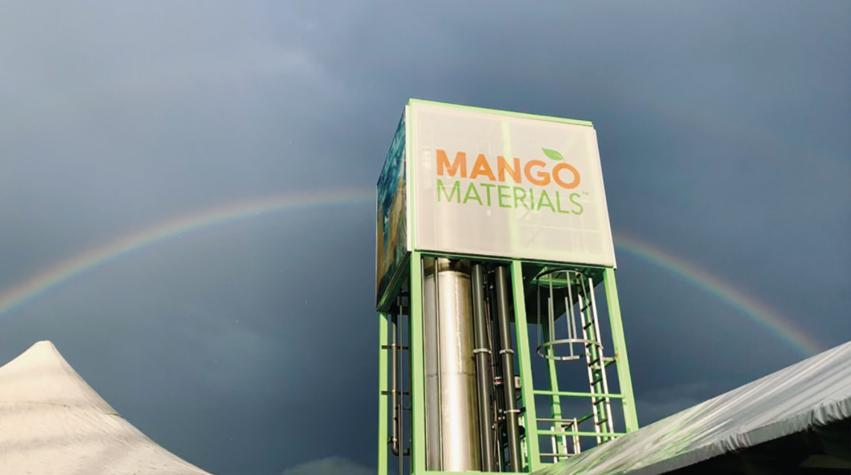
Main Image courtesy of Mango Materials.
This article originally appeared in the ChE Spotlight column in the August 2026 issue of CEP. Members have access online to complete issues, including a vast, searchable archive of back issues found at www.aiche.org/cep. Learn more about AIChE membership.