
Disclosure: This post is sponsored by b12 and reflects their views, opinions, and insights.
As artificial intelligence continues to reshape pharmaceutical research, one of the biggest challenges facing the industry is translating AI's potential into practical, lab-ready applications. The AIChE Pharmaceutical Discovery, Development and Manufacturing (PD2M) Forum is bringing that conversation to the forefront at its upcoming PD2M AI for Pharma Conference, taking place May 5–6, 2026 in Cambridge, MA. The event will convene scientists, engineers, and industry leaders to explore how AI and machine learning are being applied across pharmaceutical discovery, development, and manufacturing.
Among the innovators contributing to this space is b12 labs, a company focused on making lab automation more accessible through AI-driven, natural-language workflows. By combining expertise in chemistry, automation, and machine learning, their team is working to bridge the gap between advanced robotic systems and the scientists who rely on them.
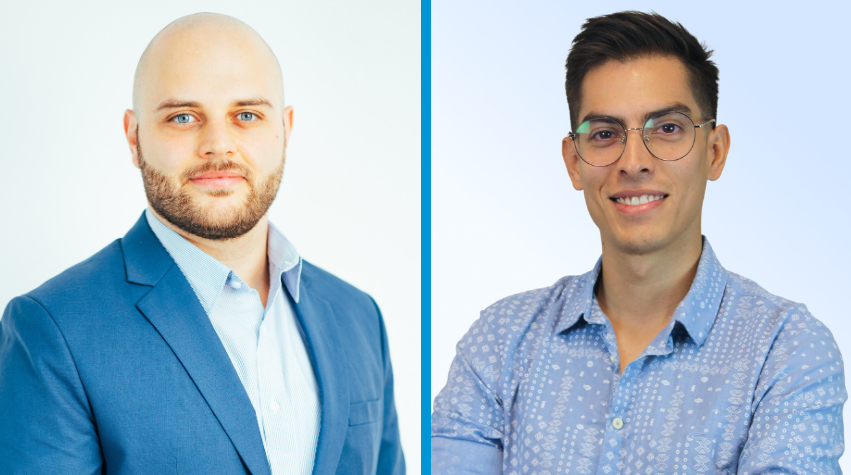
We spoke with b12 co-founders Zlatko Jončev and Andres Marulanda Bran to discuss how AI can move beyond theory to drive real progress in pharmaceutical labs, and what the future of autonomous chemistry could look like.
What problem did you set out to solve at b12, and what expertise does the b12 team offer?
Zlatko: At Chemspeed, I built and optimized automation hardware, but pharma labs rarely leveraged its full potential. The bottleneck wasn’t the robots; it was ease of use. Drawing on my medicinal chemistry experience from Roche, it became clear that bridging that gap required deep knowledge of chemistry, lab automation, and AI.
Andres: At EPFL (École Polytechnique Fédérale de Lausanne), with ChemCrow, we were the first to demonstrate that an AI agent could plan and execute a chemical synthesis autonomously. This technology bridged the gap between the different tools scientists have been building, including robotic labs. The question then became: can we take this into actual labs and make robotic labs productive? That's exactly what we're doing at b12, bringing together AI, chemistry, and automation into a single platform.
Across the industry, people know they need to incorporate AI to optimize and accelerate discovery; but general-purpose AI keeps missing the nuance in chemistry. How do you approach that gap?
Andres: Most AI approaches treat chemistry as purely a data scale problem, assuming more reactions automatically means better performance. But this misses many nuances, like why you'd use protecting groups in a synthesis, or what happens when your reaction mixture turns into a foam. The real gap is how to capture this information and what to do with it. Our goal at b12 is to capture all this nuance, the messy reality of lab work, and train systems to adapt to it, all through natural language that allows AI to act more like a smart colleague than a black-box algorithm.
Zlatko: And because our team speaks chemistry natively, the system isn't just technically capable; it's designed to be used by chemists. That makes the outputs actionable in a real lab.
Pharma synthesis often involves complex multi-step reactions that need flexibility. What role can strategy-aware retrosynthesis and AI-guided planning play here?
Zlatko: Traditional retrosynthesis tools propose routes by focusing on one step at a time, but they often ignore the synthetic strategy of the whole route and whether it's even applicable to automated platforms.
Andres: Our recent work shows that LLM-driven chemical reasoning can guide synthesis planning in a way that mirrors how chemists actually think, considering protecting groups, feasibility, and starting material preferences all at once.
Zlatko: On the execution side, our AI coordinates reaction prediction, condition optimization, and robotic code generation. And because the platform is vendor-agnostic, the same workflow runs on Chemspeed, Unchained, Opentrons, and more. We built in flexibility from day one.
There's a lot of theoretical talk out there about the potential for AI to optimize reactions and streamline research. Can you share a concrete example of how AI-guided planning changes outcomes?
Andres: Traditionally, a chemist might run 8–12 iterations to optimize a reaction, which can take weeks. With b12, the scientist describes the goal in natural language, our AI agents plan the experimental design, generate the robotic code, and execute the reaction.
Zlatko: In one pilot with a major pharma partner, the system achieved full conversion on the first plate design across several complex reaction types. We compressed weeks of iterative work into days, saved reagents, and gave scientists access to advanced design and analysis tools that accelerated their research.
Looking ahead, what does the autonomous chemistry lab of 2030 look like, and what still needs to be solved?
Andres: We see AI agents closing the gap between computational planning and real-world lab execution. Labs will run complex synthesis workflows autonomously, freeing scientists to focus on creative directions.
Zlatko: Some challenges remain: scaling across chemistry domains, integrating more diverse hardware, and building trust in fully autonomous systems. But the trajectory is clear. AI-guided, flexible, and highly efficient labs are coming. Our research at EPFL and b12 shows it's already feasible.
Disclosure: This post is sponsored by b12 and reflects their views, opinions, and insights.